To add a reference you need to go to the References tab.
You click the 'Add Reference' button on a section where you want to add the reference. You then get the choices to add a reference manually, from a PubMed ID, from a RIS file (Endnote, Mendeley, RefWorks and so on) or a RevMan5 file.
Importing different file types
A RIS file is a file containing reference data that can be exported from all major reference managers (Endnote, Mendeley, RefWorks and so on), or lists in PubMed, Epistemonikos, Ovid or other reference sites.
When importing from PubMed using the 8-number PubMed ID, it will pull in all the information PubMed contains about that reference.
When importing a RevMan5 file as a reference, see: Adding a RevMan5 file as a reference.
When importing from PubMed using the 8-number PubMed ID, it will pull in all the information PubMed contains about that reference.
When importing a RevMan5 file as a reference, see: Adding a RevMan5 file as a reference.

Moving and editing references
1. Click the 6-dot icon to move the reference up and down to change the order, which will be the order of references in the text (see note above).
2. Click the pencil icon to edit the reference information. In edit you can add study type, add a PubMed ID (that will create a link to the PubMed site), DOI (that will create a link to the Journal site) or a URL.
3. You can also attach files to the reference, including PDFs (e.g. appendices), images (e.g. forest plots), as well as Excel files or Word documents (e.g. supporting data).
4. You can see where the reference is used in the Places used tab. In the usage tab, you can remove connections to PICOs and recommendations. You can also add information about the reference, but this is only available to authors of the guideline (e.g. abstract, results, comments).
4. You can see where the reference is used in the Places used tab. In the usage tab, you can remove connections to PICOs and recommendations. You can also add information about the reference, but this is only available to authors of the guideline (e.g. abstract, results, comments).

Reference ordering
Initially, references are ordered in the sequence in which they are added. You can change this order manually (see point 1 in Moving and editing references above) or automatically reorder them to match the order in which they are cited in the text. To automatically rorder, select 'Add reference' and then 'Order references based on citation placement'. To automatically reorder, select 'Add reference' and then 'Order references based on citation placement'.
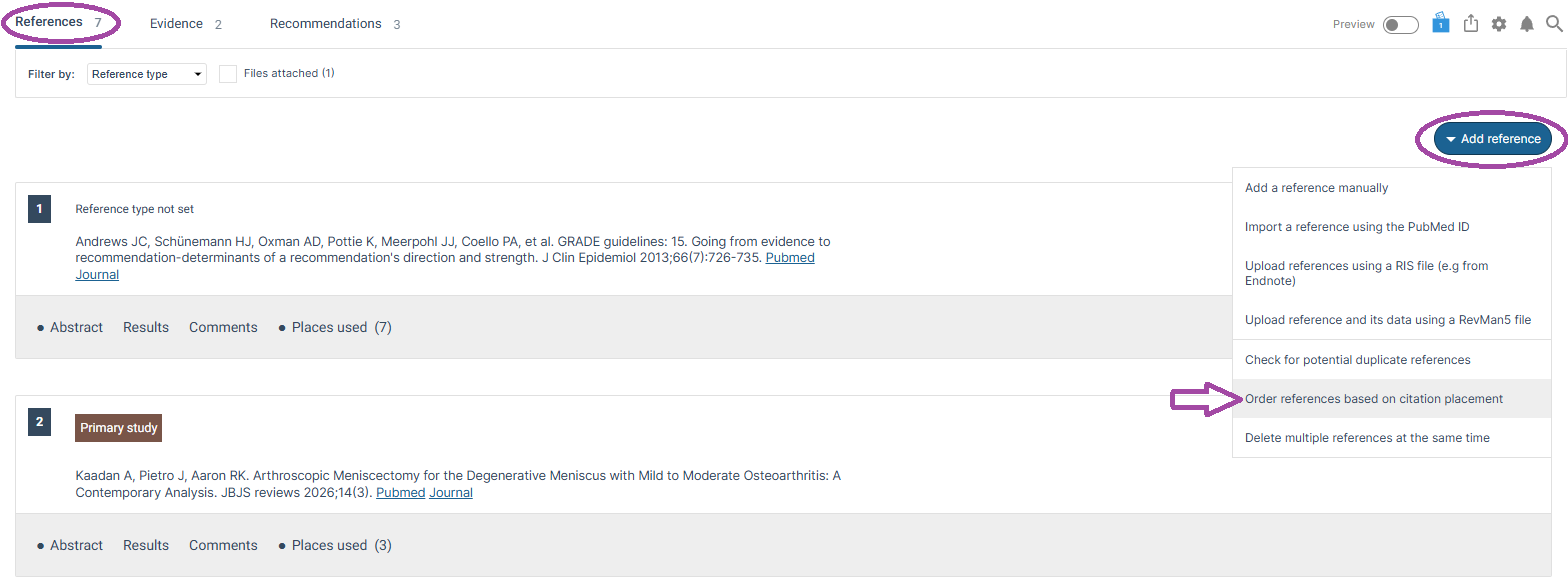
You will then see a pop-up box appear, and you will need to click on Reorder (please note the wording of the pop-up box will vary depending on whether you choose to include PICOs in your PDF export - more information about changing your PDF settings can be found here How do I make a PDF version of my guideline (with or without publishing)?).
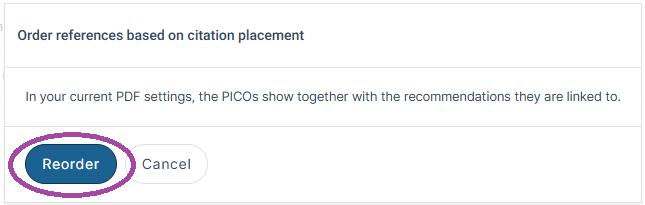 It may take a few moments for the automatic reordering to take place, particularly if you have a large number of references.
Last Updated: 28 April 2026
Was this article helpful?
That’s Great!
Thank you for your feedback
Sorry! We couldn't be helpful
Thank you for your feedback
Feedback sent
We appreciate your effort and will try to fix the article